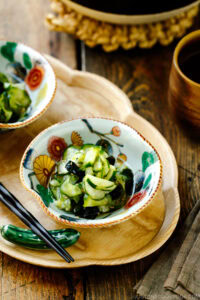
Japanese Cucumber Salad (Sunomono) (Video) 酢の物 15 MINS
Appetizers, Sides
Ingredients
Japanese or Persian cucumbers
Kosher salt
Dried wakame seaweed
Toasted white sesame seeds
For the dressing:
Rice vinegar (unseasoned)
Sugar
Kosher salt
Soy sauce
For the Dressing:
4 Tbsp rice vinegar (unseasoned)
2 Tbsp sugar
½ tsp Diamond Crystal kosher salt
½ tsp soy sauce
For the Sunomono:
2–3 Japanese cucumbers (or 3–4 Persian cucumbers; 11 oz, 300 g)
1 tsp Diamond Crystal kosher salt
1 Tbsp dried wakame seaweed (3 g; 20–30 g after rehydration)
½ Tbsp toasted white sesame seeds
For the Variations (Optional)
4 pieces real or imitation crabmeat (skip for vegan/vegetarian)
2 oz octopus sashimi (boiled octopus) (skip for vegan/vegetarian)
2 Tbsp shirasu (boiled salted baby anchovies) (skip for vegan/vegetarian)
2 red radishes (for vegan/vegetarian)
Directions
Substitutions
Japanese or Persian cucumbers: If you can’t find them, English cucumbers work well as a substitute as they don’t have large seeds like American cucumbers. Just scoop out the seeds with a spoon to prevent excess moisture from diluting the dressing.
Dried wakame seaweed: Skip it if you’re not a fan or can’t find it, or swap it with other veggies—see my suggestions below.
Sesame seeds: I love their nutty aroma, but sunomono in Japan is often made without them. Feel free to skip them.
Soy sauce: For gluten free, use GF soy sauce.
– Make the dressing. Combine the dressing ingredients in a saucepan and whisk over medium heat until the sugar dissolves completely. Alternatively, you can use a microwave-safe bowl and heat it in the microwave. Set aside to cool.
– Rehydrate the dried wakame seaweed. Soak it in a bowl of water for 5 minutes.
– Peel, slice, and salt the cucumbers. Meanwhile, use a vegetable peeler to peel the skin in a striped pattern and slice them thinly into rounds with a sharp knife. Sprinkle with kosher salt, gently rub it in, and set aside for 5 minutes.
Assemble
– Squeeze out the liquid. Squeeze out the rehydrated wakame seaweed and sliced cucumbers and add them to a medium bowl.
– Toss in the dressing and serve immediately. Add the cooled dressing and sesame seeds and toss it all together. Optional – If you’re adding one of the optional ingredients, toss it in now.
Then, serve the salad in individual bowls for a composed meal or in a large bowl to serve it family-style.
Add seafood or fish. In Japan, it’s common to boost the protein, nutrition, and flavor of this dish by adding seafood or fish. I highly recommend trying thinly sliced boiled octopus, shirasu (boiled baby anchovies), or real/imitation crabmeat. You’ll find instructions for incorporating these optional ingredients at the end of the recipe below—plus, don’t miss my Japanese Cucumber Salad with Crab recipe!
Add other crunchy and colorful vegetables. To add extra texture, fiber, and nutrients, try enhancing this salad with thinly sliced red radish, crisp strips of orange carrot, or white or red onion.
Crush the sesame seeds for a different texture. I leave toasted sesame seeds whole in this recipe, but you can also grind them lightly in a mortar and pestle and mix the crushed seeds with the dressing. Check out my Cucumber Salad with Sesame Soy Vinaigrette recipe!
With fish: The light cucumber taste complements the delicate flavors of classic Miso Cod and Teriyaki Salmon.
With meat: The crunchy, sweet-and-sour salad is a wonderful counterpoint to rich meat dishes like Baked Chicken Katsu and Simmered Beef and Tofu.
With another side dish: In Japanese cuisine, we often serve in the same meal a variety of plant-forward dishes like Spinach Ohitashi and Okra with Ginger Soy Sauce.
With rice: When crispy and sweet corn is in season, I love making Japanese Corn Rice.
Storage Tips
To store: Keep in an airtight container and store in the refrigerator for up to 2–3 days (2 days for the seafood variations and 3 days for the classic version). However, the cucumber may release more moisture and the sauce may get diluted, so enjoy it soon!
Gather all the ingredients.
To Make the Dressing
In a saucepan, combine 4 Tbsp rice vinegar (unseasoned), 2 Tbsp sugar, ½ tsp Diamond Crystal kosher salt, and ½ tsp soy sauce. Alternatively, you can use a microwave-safe bowl and heat it in the microwave until the sugar dissolves.
Place the saucepan over medium heat and whisk the ingredients together well (I use this whisk). Once the sugar dissolves completely, remove from the heat and let it cool. Tip: If you decrease the sugar amount (which I don't recommend), you may find that the vinegar tastes too strong. If it's still too strong for you after adding the cucumbers, you can dilute it at this stage with a very small amount of Dashi (Japanese soup stock), Vegan Dashi, or water.
To Make the Sunomono
Soak 1 Tbsp dried wakame seaweed in a bowl of water and let it rehydrate for 5 minutes.
Meanwhile, peel the skin of 2–3 Japanese cucumbers alternately to create a striped pattern. Then, thinly slice the cucumbers into rounds.
Sprinkle 1 tsp Diamond Crystal kosher salt on the cucumber and gently massage it in. Set aside for 5 minutes. The salt draws out the moisture from the cucumbers so it doesn't dilute the dressing later.
Use your hand(s) to squeeze out the liquid from the rehydrated wakame seaweed and add it to a medium bowl.
Squeeze out the liquid from the cucumber slices. Add them to the bowl with the wakame.
Add ½ Tbsp toasted white sesame seeds and pour the dressing on top.
Toss to combine everything together. Serve in individual bowls or a large serving bowl.
To Make the Variations
Crabmeat: Cut 4 pieces real or imitation crabmeat into thirds lengthwise. Add to the cucumber and wakame seaweed mixture in Step 7.
Boiled octopus: Slice 2 oz octopus sashimi (boiled octopus) thinly. Add in Step 7.
Boiled salted baby anchovies: Add 2 Tbsp shirasu (boiled salted baby anchovies) in Step 7.
To Store:
Keep in an airtight container and store in the refrigerator for up to 3 days for the classic version and 2 days for the seafood variations. However, the cucumber may release more moisture and dilute the sauce, so enjoy it soon!
Nutrition
Calories: 39kcal, Carbohydrates: 5g, Protein: 3g, Fat: 1g, Saturated Fat: 1g, Polyunsaturated Fat: 1g, Monounsaturated Fat: 1g, Cholesterol: 11mg, Sodium: 151mg, Potassium: 106mg, Fiber: 1g, Sugar: 4g, Vitamin A: 55IU, Vitamin C: 2mg, Calcium: 30mg, Iron: 1mg